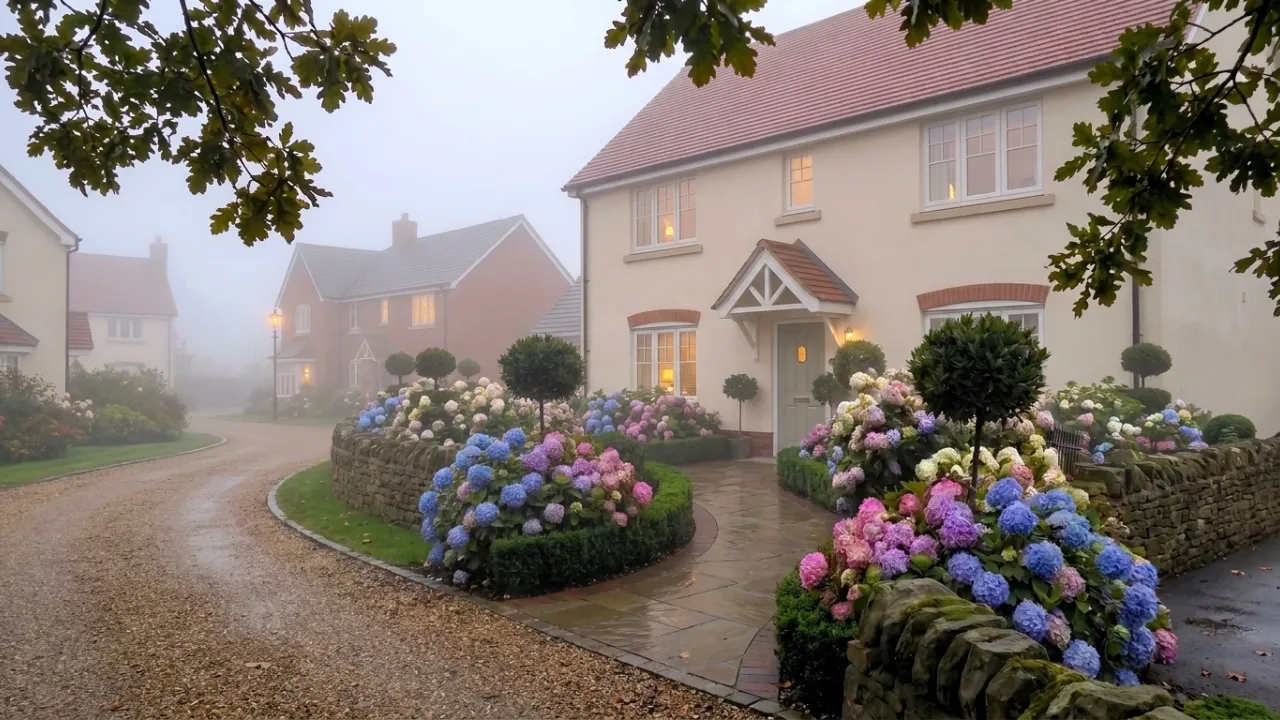
Topiary standards change the math of a front border immediately. Stick a mophead hydrangea in the dirt and it spills outward into a broad, shapeless mass. Plant a dozen together and you get a billowy cloud with zero vertical breaks. That is why these lollipop standards work. Their straight, bare stems slice cleanly through the petal canopy, hoisting dark green globes right into the mid-story. You get hard geometric form parked dead center inside soft botanical sprawl. It feels intentional. It stops the eye from sliding down the driveway without pausing.
Gardens go flat without deliberate upright markers. When you run a single horizontal plane across an entrance—lawn, low perennials, doorstep—the approach looks lazy. Stripping the lower branches off privet or bay forces negative space between the soil line and the sheared foliage above. Sunlight slips under the crown. The dwarf plants underneath get actual air circulation, reducing fungal mildew after summer showers. Higher up, the dense, clipped ball stands solid against the sky, keeping that identical crisp silhouette long after the hydrangeas brown off and drop their foliage in November.
Punctuation and Height Contrast with Clipped Standard Topiary
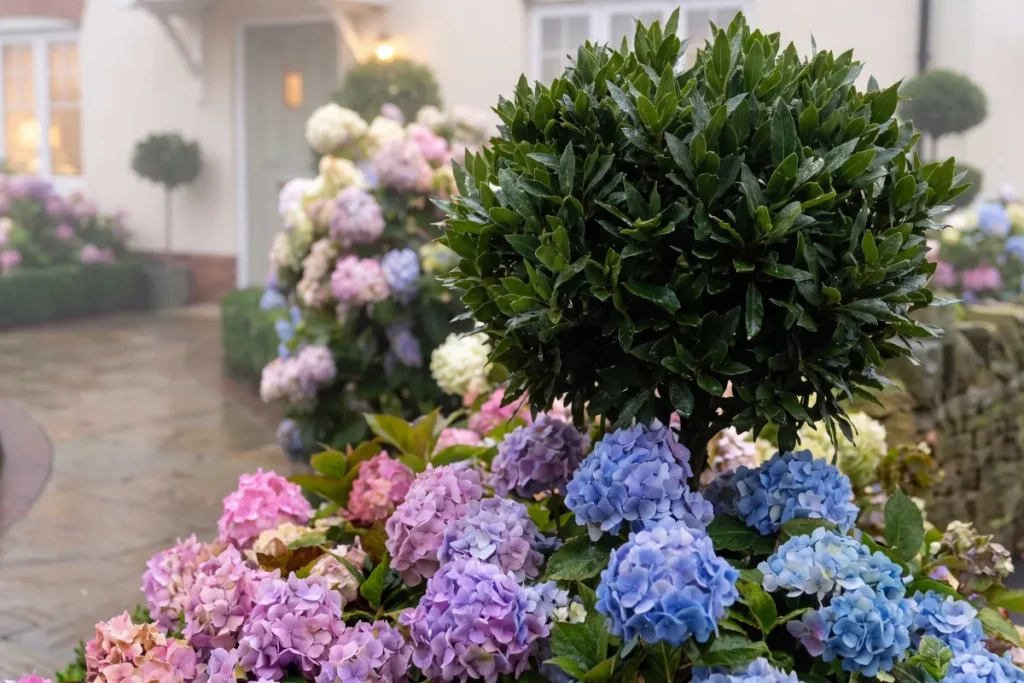
Geometric shearing requires blunt discipline. A round ball does not happen by accident; it takes regular maintenance with clean sheep shears or two-handed hedge clippers. In this bed, clipped evergreen spheres jut straight out of huge hydrangea heads. The contrast is immediate. On one hand, you have loose, fragile florets shifting between pale blue, mauve, and soft pink depending on soil chemistry. On the other, you have a tight, unyielding mass of tiny dark leaves pruned to a millimeter of their lives.
Spacing along this curve matters just as much as pruning. If you line topiary standards up in a row like fence pickets, the front path feels like a security checkpoint. Space them irregularly along the arc of the wall, however, and they act like stepping stones for the eyes. You spot the first ball right at the driveway mouth. You catch the second near the front door. It breaks the visual bulk of the flower bed, pulling focus straight toward the entryway porch.
Strategic Placement of Exterior Carriage Lanterns and Pathway Posts
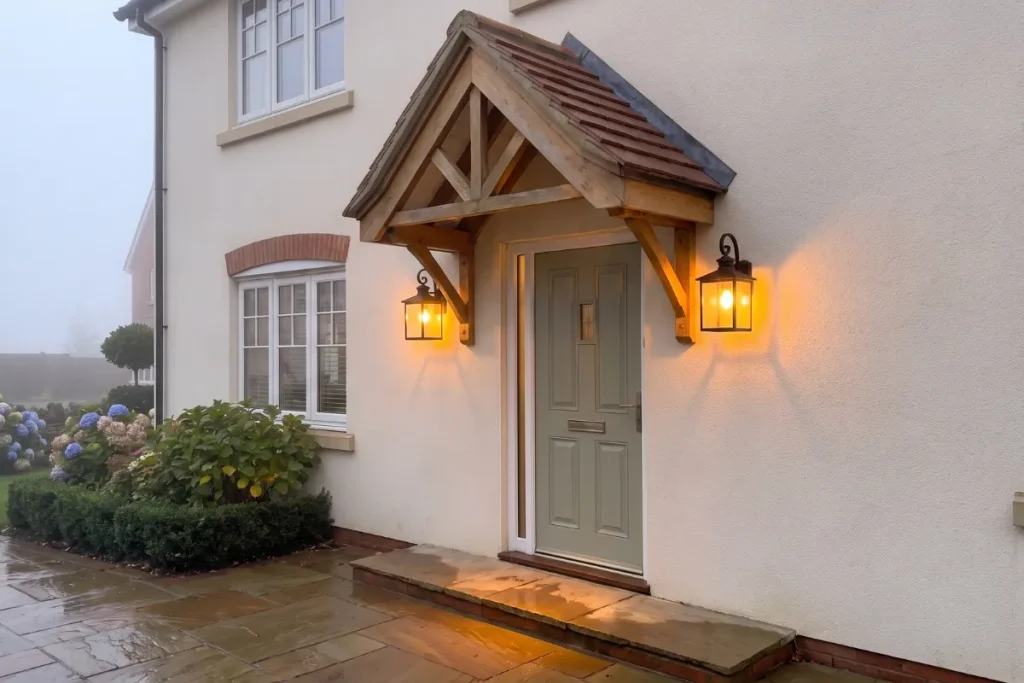
Lighting fixtures pull double duty. By day, they sit as dark cast-iron hardware against off-white walls. Come nightfall, they dictate where a visitor places their boots. Flanking the front doorway, two wall-mounted carriage lanterns break up the flat masonry facade. Black iron brackets hold clear bevelled glass boxes. They sit low on the wall—roughly eye level—casting warm pools of light directly over the stone doorsill rather than blasting glare into the street.
Move ten yards down the approach, and a freestanding lantern post anchors the gravel fork. It is a workhorse detail. Planted directly beside the low fieldstone boundary, the black metal shaft marks the dividing line between the shared road and the private sandstone path. The dark factory-style coating matches the wall sconces near the door, creating a quiet hardware rhythm through the landscape. When moisture hangs in the air, the bulbs throw long, amber reflections across the damp flags.
Framing Planting Beds with Low Clipped Box Hedging
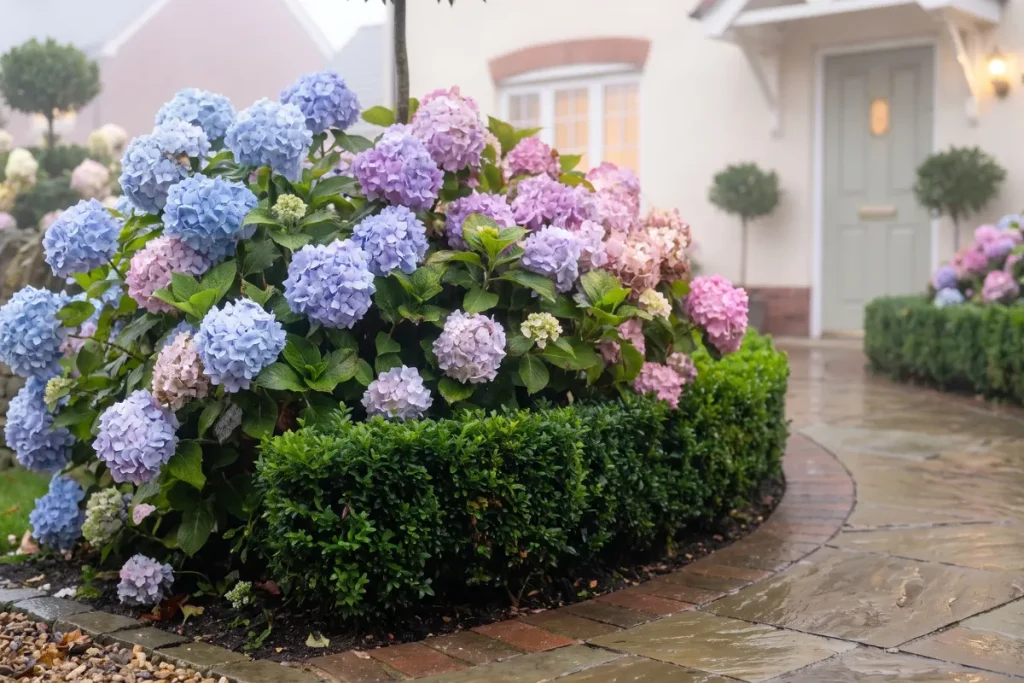
Without a bottom border, hydrangeas look messy against hard masonry. Rain hits the blooms, the heavy flower heads drag stems into the dirt, and leaves rot across wet stone. A clipped dwarf box hedge solves that problem instantly. Running parallel to the curved wall, it forms a tight, 30-centimeter-high living barrier. The green leaves interlock so tightly that heavy mophead branches literally rest on top of the hedge rather than collapsing into the walkway.
Think of it as architectural moulding for the garden. Top surfaces are clipped level; sides drop perpendicular to the ground. That crisp horizontal line creates visual separation between rough fieldstone below and pastel flowers above. It also hides the bare, leggy lower stems that mature hydrangeas inevitably develop by late summer. You see vibrant blooms above, a neat strip of dark foliage below, and zero dead twigging in between.
Material Transitions: Crisp Clay Paver Edging and Wet Sandstone
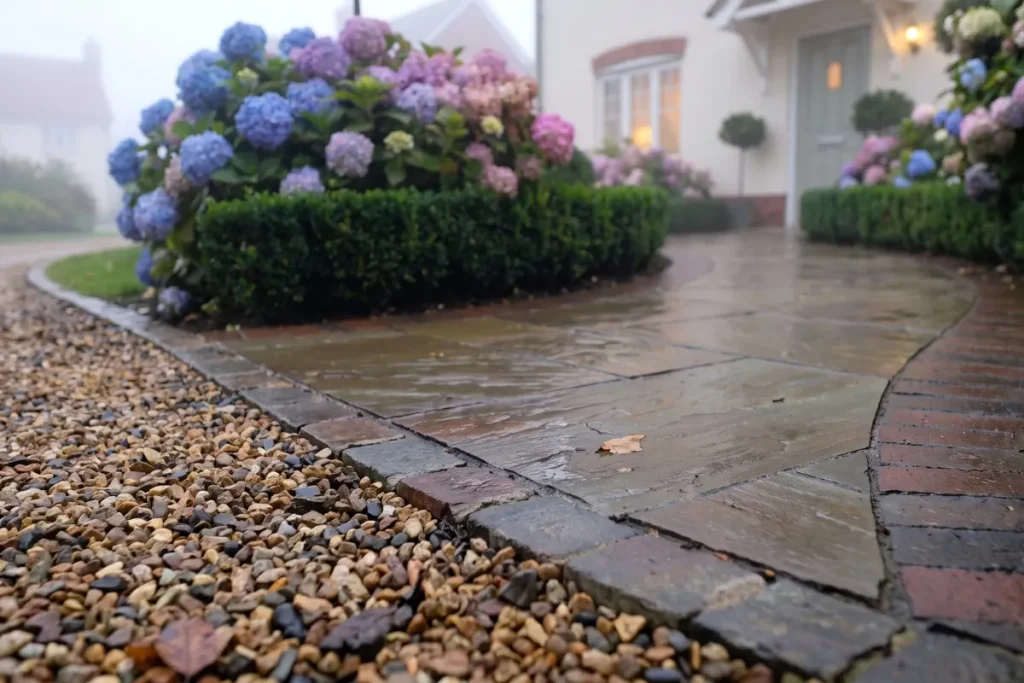
A driveway transition will make or break an entrance design. Push loose gravel directly against large flagstones, and you spend your weekends sweeping pea shingle off the front step. The solution here is a curved soldier course of dark clay pavers. These dense, fired pavers form an edge restraint bedded into concrete. They lock the loose gravel into the vehicle lane and establish a clear, immovable lip for the footway.
Once your boots leave the gravel, you step onto broad slabs of riven sandstone. The slabs are laid with tight, mortared joints in an irregular pattern. Moisture brings out dark olive and graphite streaks across the stone surfaces, giving the wet path a rugged texture that prevents slips. The broad slabs give you plenty of room to take long strides without brushing wet shrubbery. The stone surface sits completely flush with the boxwood border, directing foot traffic smoothly toward the timber-framed porch without cutting corners across the grass.
Balancing Masonry Textures: Fieldstone Coping and Smooth Render
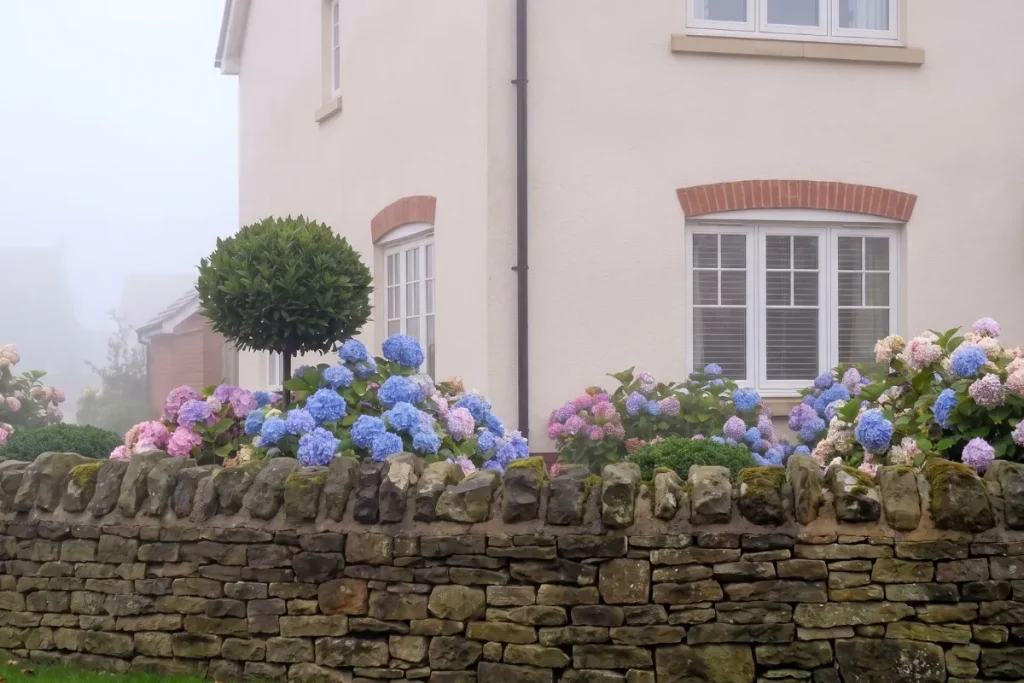
Exterior styling works best when rough and smooth textures sit side by side. Here, the boundary wall is pure, dry-laid fieldstone. No visible mortar coats the joint faces. Flat coping stones sit dry along the ridge, their edges gathering moss and lichens in damp spots. The masonry feels heavy, ancient, and grounded in the dirt. It serves as an unpolished plinth for the entire floral scheme.
Step back, and you see that rough stonework set directly against clean residential finish. The house facade is coated in a flat, off-white render, interrupted only by the red-brick arches above the casement windows and the clay tiles of the pitched roof. Because the wall is rugged and the house is smooth, neither surface competes for attention. The pale render reflects ambient daylight down into the garden, while the dark, weathered stone anchors the foreground. It is a lesson in material restraint: let rough stone be rough, keep painted render clean, and let clipped topiary bridge the gap.
Discover more practical exterior styling guides, traditional planting combinations, and hardscaping details at BySophieSweet.com. Explore our guide to traditional exterior accents and lantern lighting to balance your entryway, or see how to frame paths with layered front garden borders.
3 thoughts on “Styling Garden Entrances with Topiary Spheres and Exterior Lanterns”