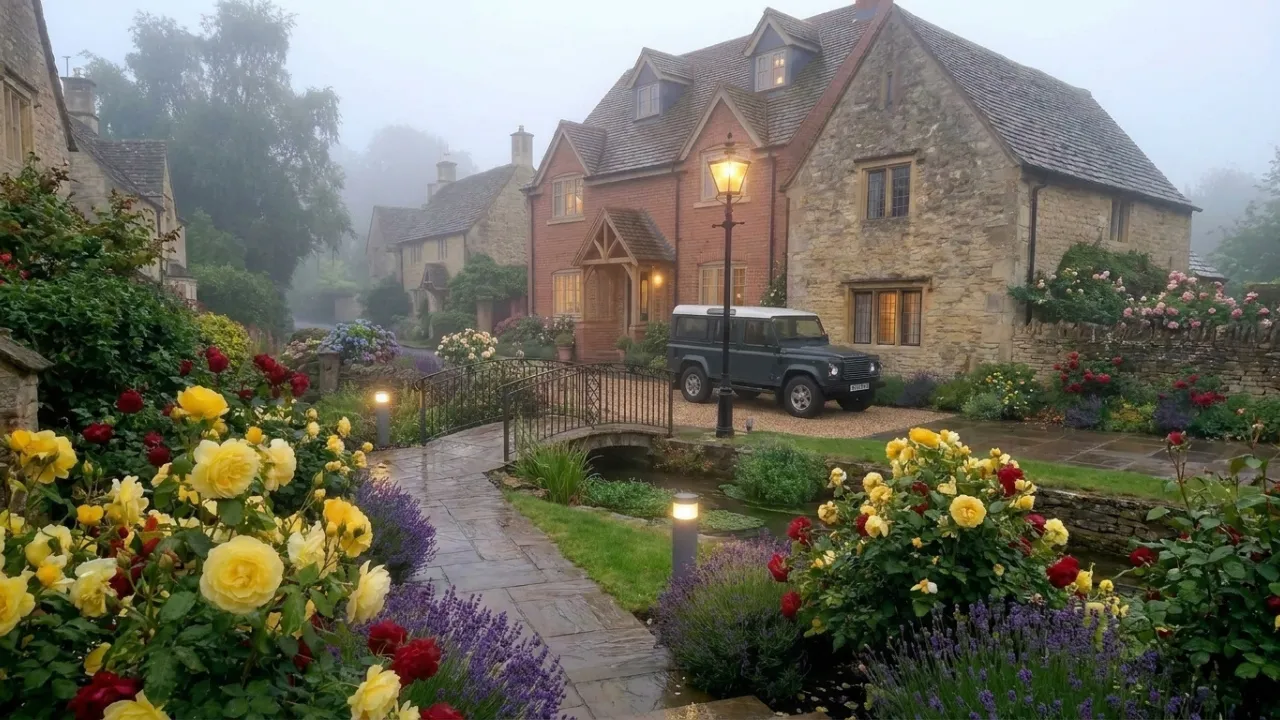
Cotswold flagstones underfoot set the whole baseline here. Broad, thick, and quarried with uneven clefts, they run straight from the roadway inward. You don’t get the slick, manufactured uniformity of cast concrete; instead, you feel every hand-tooled split in the rock. The joints are pointed tight with traditional lime-rich mortar, keeping damp from working behind the edges during cold snaps. It is a solid spine for foot traffic. It takes the brunt of winter mud without flinching.
Right beside the paving, the walk gives way to loose aggregate. Golden pea gravel covers the wider driveway bay, held inside a clean stone edge. Footpaths need firm purchase, but parking bays need drainage, and loose gravel gives you that instantly. Rain hits the gravel and drops straight down to the soil sub-grade. No standing puddles. No slick film of mud. Plus, you get that dry crunch whenever tires pull in off the tarmac, which works as an unscripted alert for arriving guests.
Get the sub-base wrong and gravel fails within a season. You need at least a solid four to six inches of compacted crushed rock beneath the decorative stones, otherwise a loaded estate car or utility vehicle leaves deep troughs in the tracks. Here, the bed stays level because the stone chips lock tight against the kerb stones. It makes the threshold easy to negotiate on foot while providing enough bearing capacity for regular vehicle use.
Engineering the Arched Bridge and Ironwork
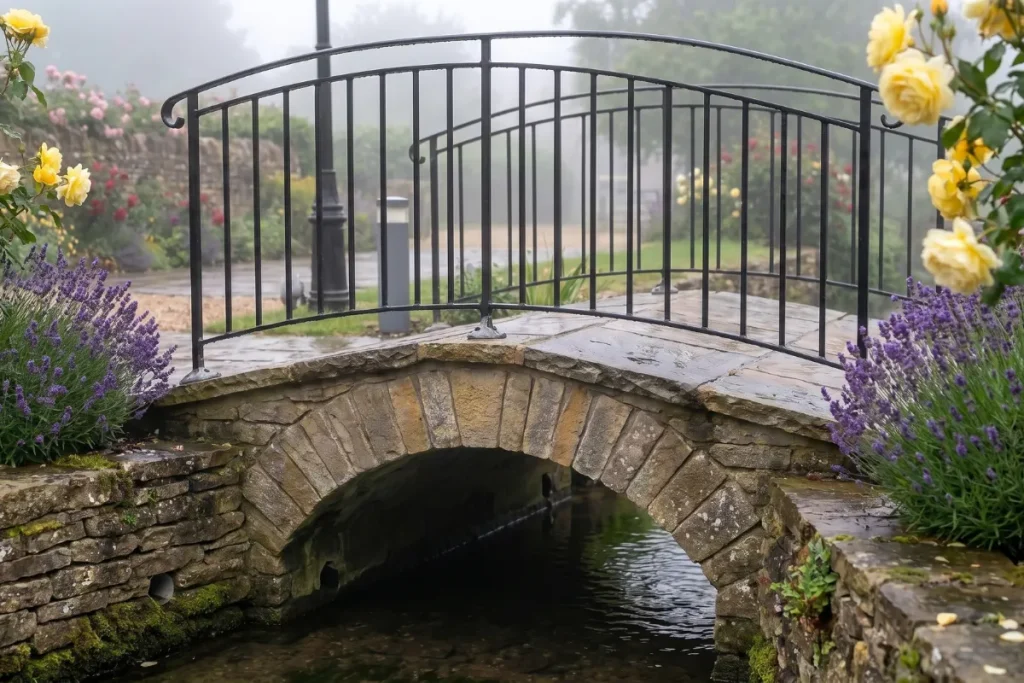
To cross the shallow culvert running along the plot, the flagstone path lifts up onto a small masonry arch bridge. It uses dressed stone voussoirs—the wedge-shaped stones that form the curve—to push the overhead weight outward into the banks. The bridge deck uses the exact same split flags as the approach path. That continuity matters. It keeps the walk cohesive rather than looking like an afterthought bolted onto the garden boundary.
The railings keep things open. Instead of running heavy stone parapets that would box in the ditch and block your line of sight, the builders dropped in a light wrought-iron balustrade painted satin black. The top rail arches gently, matching the stone curve below, with vertical pickets anchored straight into the stone base blocks. Lead-caulked sockets seal the iron legs into the masonry, which stops water from collecting in the drilled holes and splitting the stone when the frost arrives.
Water pressure is the real enemy of small bridges like this. The abutment walls incorporate small weep holes just above the water line to let ground moisture seep out from behind the stone backing. Without those simple drainage gaps, trapped hillside runoff builds up behind the stonework and pushes mortar joints loose over time. The masons also gave the deck flags a subtle cross-fall, so surface rainwater runs straight off the edges instead of pooling in the center.
Dry-Stone Retaining Walls and Soil Stabilization
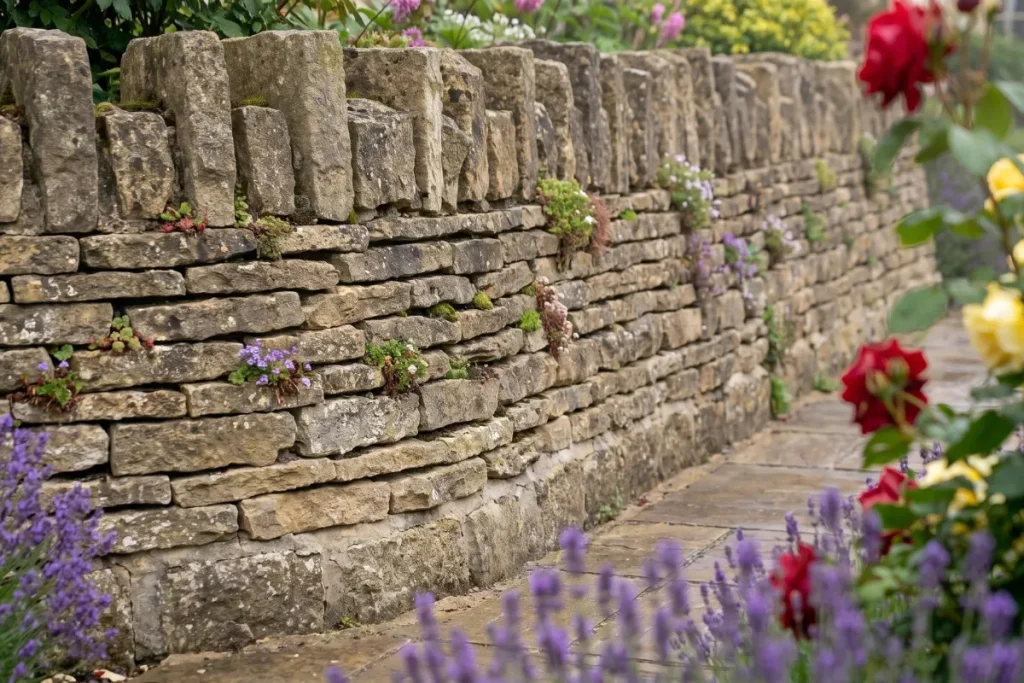
Holding back the raised garden beds requires serious mass, and dry-stone walling does the job better than rigid poured foundations. The masons stacked flat-faced Cotswold limestone with a distinct inward lean—what builders call a batter. That angle forces the weight of the stone back against the dirt bank, using gravity to resist soil heave. There is no cement holding the outer face together, which is deliberate. Water moves freely through the open gaps, so heavy rains never turn into a hydro-static dam behind the wall.
Across the top of the wall, heavy stone coping units sit upright, side by side like books on a shelf. They pin down the smaller courses beneath them and take the weathering. Lower down, near the path steps, the wall shifts to a mortared core where extra lateral strength is needed against foot traffic. It gives you structural muscle where people walk, but leaves the upper runs rough and open for alpine plants to root into the seams.
Settlement happens naturally with dry stone. As ground temperatures fluctuate and the earth swells, the loose courses adjust without cracking in half. Mortared walls tend to shear when the ground heaves; dry stone just shifts slightly and settles back into its bed. The builders graded the soil back from the top coping line, keeping wet loam from spilling over the stone face and staining the flags below during prolonged storms.
Threshold Lighting and Directional Hardware
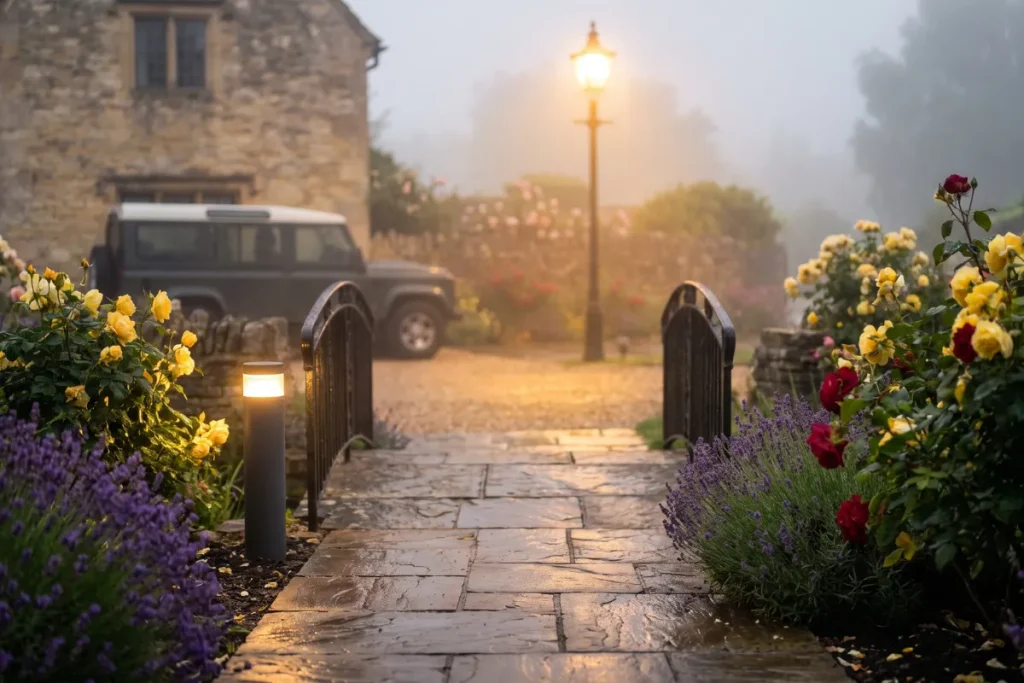
Good garden hardscaping falls apart after dark if the lighting is clumsy. Here, small dark bollards sit right down near ground level at key transition spots: beside the bridge threshold and along the bend in the stone path. They don’t blast light into your eyes. Their shielded heads cast warm cones downward across the flags, showing up the split texture of the stone and clearly marking the edge between paving and ditch.
Up by the gravel forecourt, a tall, black cast-iron lantern post takes over the ambient work. It gives you high-level clearance, throwing an even pool of warm illumination across the wider driveway without throwing harsh glares back at the house windows. The black iron column acts as an anchor in the open gravel expanse, giving the eye a vertical reference point against the flat ground plane.
All the cabling runs through buried high-density conduit tucked beneath the gravel sub-base and stone risers. You don’t see cables trailing through planting beds. The junction boxes sit below removable flag covers for easy access when a lamp needs swapping out. Crucially, the light color stays down around 2700 Kelvin, pulling out the warm yellow tones in the Cotswold stone rather than washing everything out in cold, clinical white light.
Integrating Aggregate Drainage and Vehicle Flow
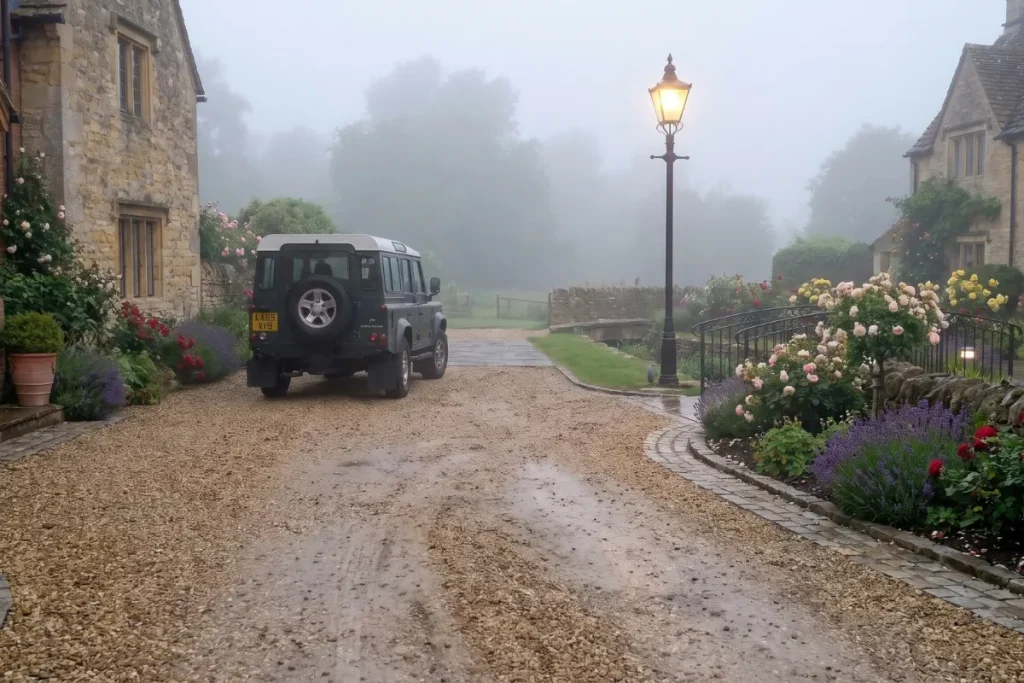
A rural driveway has to accommodate practical movement: turning circles, delivery vans, and daily parking. The gravel track curves smoothly past the bridge crossing, giving enough apron space for an off-roader to turn and park without grinding against the garden walls. By using permeable aggregate instead of asphalt or solid setts, the whole forecourt acts as a massive drainage soakaway. You don’t need ugly plastic linear drainage channels or metal grates cutting across the stone apron.
Gravel depth needs tight control—keep it to about an inch and a half or two inches at most. If you lay it thicker, car wheels sink into the stone and spin; if you spread it too thin, the gray sub-base rocks show through after a week of rain. Here, the stone sits over a compacted foundation layer of angular scalpings that lock together like puzzle pieces under a vibrating roller. It creates a solid platform that will not rut under the weight of a heavy four-wheel drive.
Quarry-dressed stone setts act as kerbs around the perimeter, pinning the aggregate in place. They prevent cars from kicking gravel into the flowerbeds or rolling stones down the slope into the stream. Maintenance comes down to a stiff garden rake once a month to pull displaced stones back into the main tire tracks. It is simple, rugged site engineering that handles everyday village life without ever looking artificial or modern.
Looking to refine your exterior spaces with durable, timeless craftsmanship? Discover more structural landscape guides and masonry inspiration on BySophieSweet.com. Learn how to grade slopes with our guide to front garden retaining walls, or explore durable pathway textures in our look at stone walls, cobbles, and paths.
1 thought on “Essential Garden Hardscaping Ideas for Country Driveways”