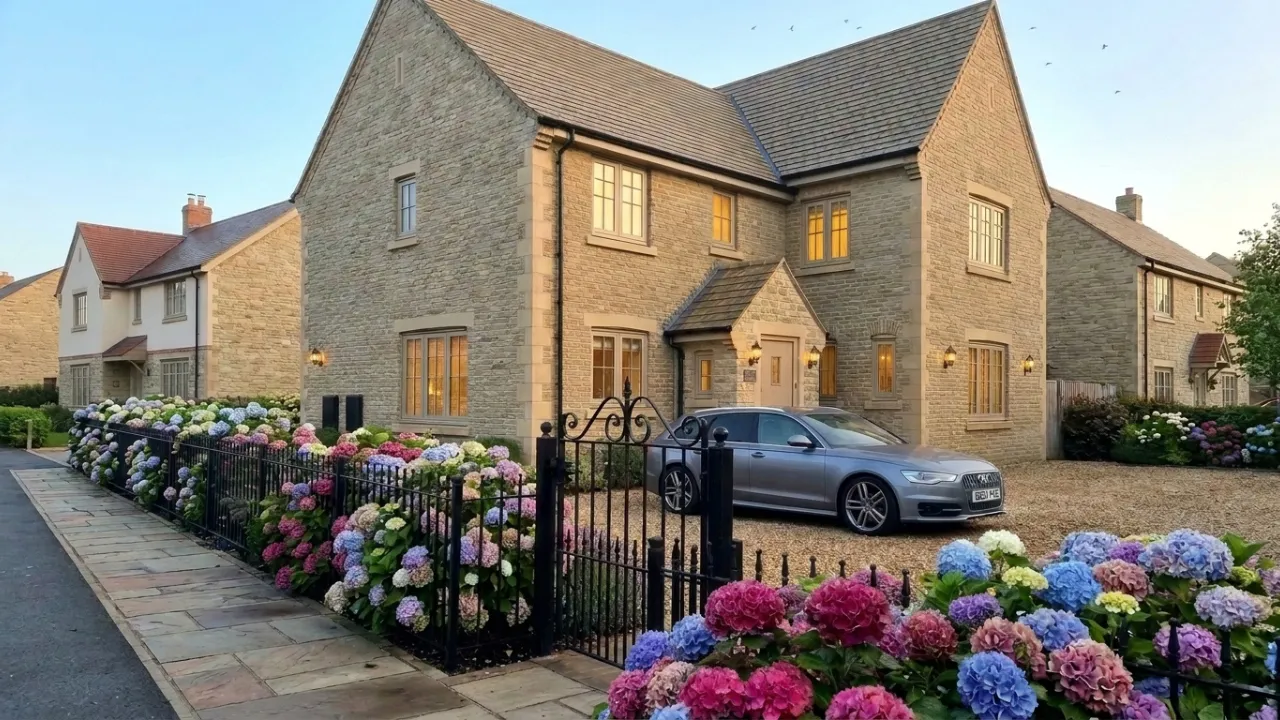
Hydrangeas shoulder against the boundary ironwork right at the public edge. It is a bold, deliberate plant choice. These mopheads do not sit back timidly near the porch footings. Instead, magenta, dusty violet, cobalt, and pale sky-blue flower heads press through the lower pickets. You step off the asphalt road, and the blooms are right at knee height. They soften what could have been a stark division between flagstone pavement and a wide gravel vehicle court. Tumbled buff stone walls and grey slate roof pitches carry serious weight. Without these dense shrub balls breaking up the ground plane, that masonry mass would look far too heavy from the curb.
Sizing Hydrangeas for Proportion and Impact
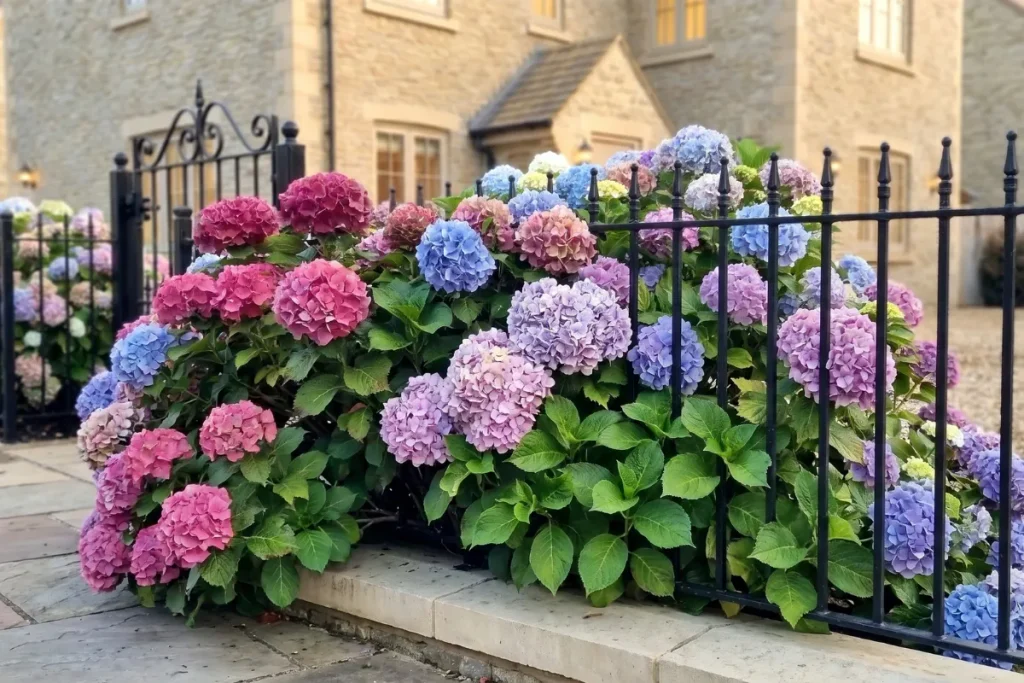
A tiny box hedge would get swallowed whole here. Small plants look silly against two stories of coursed stone and broad gable ends. Scale dictates everything on a wide suburban plot. These mopheads measure four feet across each. That bulk matches the house footprint point for point.
They do not stay polite. Stems arch forward under the sheer mass of wet midsummer flower heads. The base of the black estate rail disappears completely under a sprawl of broad, notched leaves. Good. Hard landscape lines need that kind of blunt disruption.
You still see through the upper rail pickets. Sightlines stay clear for pulling cars out across the driveway apron, yet the garden never feels exposed to passing foot traffic. Plant spacing here avoids gaps. The crowns knit into an unbroken bank, holding their shape through scorching sun or downpours without splaying wide open. That demands deep, water-retentive topsoil below the stone coping. Dry roots mean floppy foliage within two hours of noon exposure. Keep the root zone mulched, and the shrub heads stay rigid right through the start of autumn frosts.
Textural Contrast and Building Character
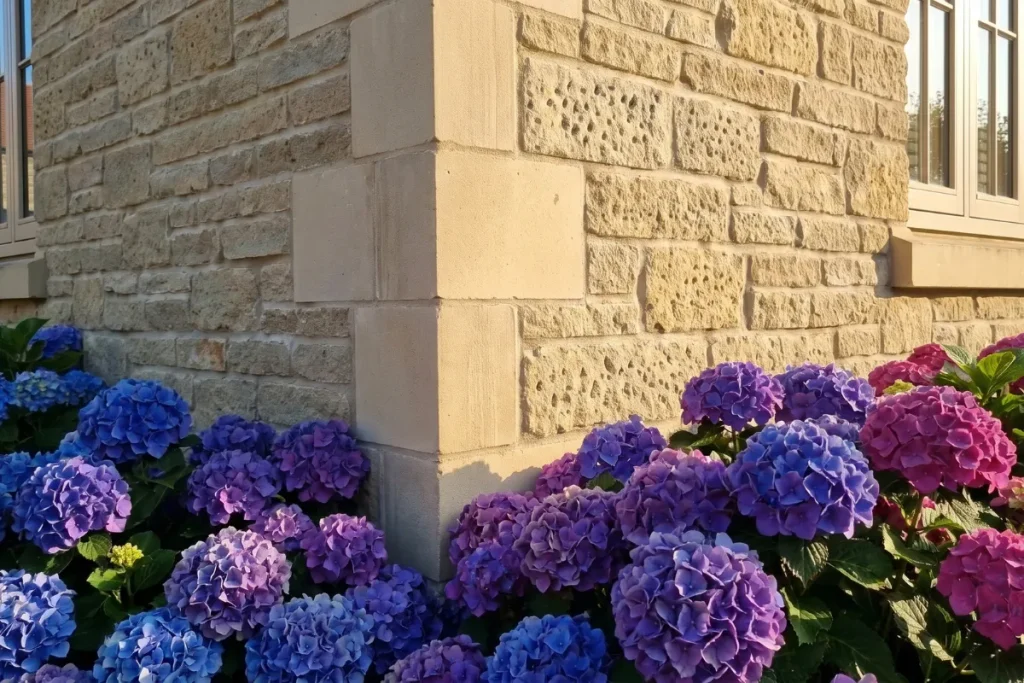
Natural stone has grain, pitting, and fractured faces. Sawn timber or flat render would fight with that texture, but rough masonry welcomes heavy-leafed deciduous growth. Look at the corners of the front elevation. Dressed ashlar quoins provide sharp vertical frames for the coursed walling. Below them, the rounded, knobby outline of the flower heads breaks the flat grade.
The color pairing does heavy lifting. Buff stone holds a pale, warm straw tone in daylight. Drop pastel pink against it, and things turn washed out fast. Throw deep royal blue, violet, and dark magenta florets against that same stone, and the entire elevation wakes up.
Up close, the masonry shows struck mortar joints and slight tooling marks on the window heads. The hydrangeas match that level of detail with thousands of tiny individual sepals packed into single globes. Overhead, slate roof valleys and dark downspouts ground the upper third of the house. Down low, the shrubs take the glare off the sunlit wall base. Everything sits tied together by physical weight, not fussy ornamentation.
Designing the Threshold with Ironwork and Gravel
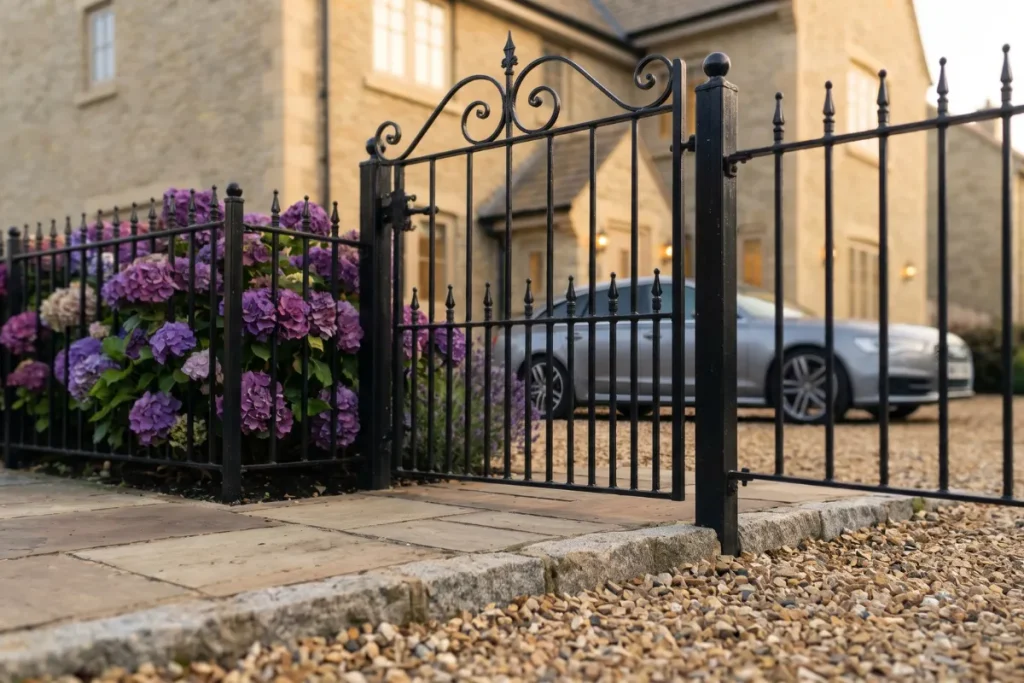
Black iron rails set the legal property boundary without turning the front yard into a fortress. It is a classic boundary detail. The vertical pickets stay narrow, topped with cast points and small scroll flourishes right above the latch gate.
Driveway gravel begins right where the iron ends. No poured concrete. No dull asphalt apron. Instead, angular crushed pea gravel fills the entire court, held tight against the sidewalk boundary by a low stone curb course. It sheds rainfall without surface puddling. You never see ponding water or grease slicks after a storm.
There is an audible element here too. Car tires pop and roll across loose stone the moment you clear the gateposts. It announces visitors before anyone rings the bell. Smooth paving flags stay reserved strictly for the pedestrian route outside the fence line. Two surfaces, two jobs. The flagstones take foot scuffs; the gravel handles wheel load. Between them sits the iron fence, smothered in purple heads.
Lighting the Path to the Front Door
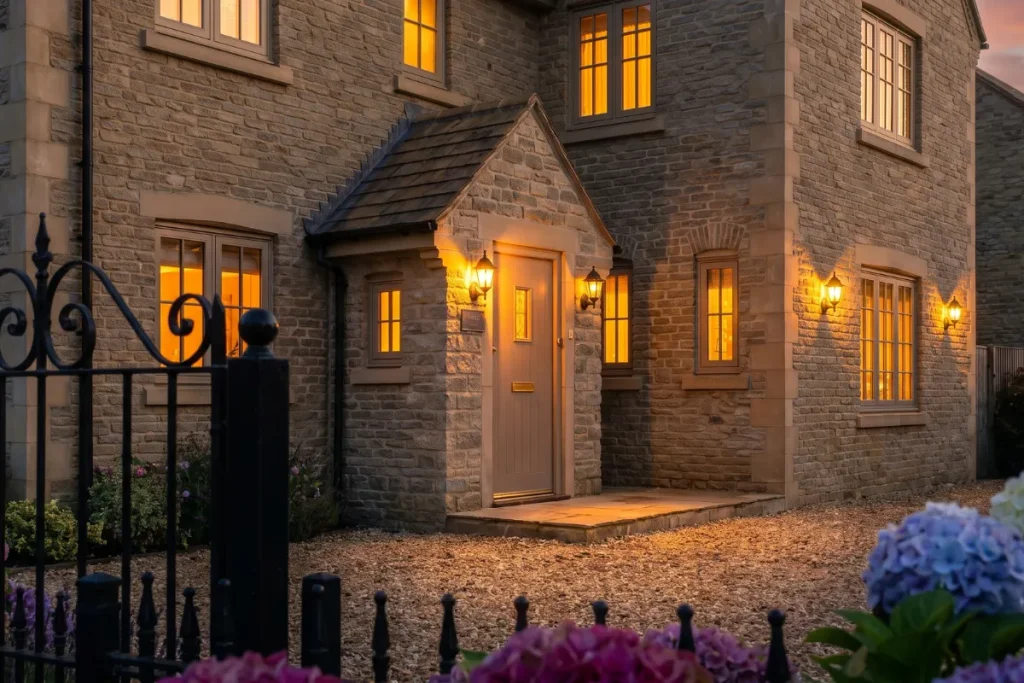
Outdoor lanterns need to show where your boots go after dark. That is their primary job. Here, black metal carriage fixtures mount directly into the stone blocks. The principal light hangs right at shoulder height on the gabled porch wall. It throws downward beam angles across the threshold stone, doorstep riser, and key cylinder.
Two more matching lanterns space out across the wider front wall. One sits between the double casement windows; the other mounts on the corner returns near the vehicle bay. They avoid light bleed into the upper bedroom windows while washing light down the rough stone face.
Inside the house, warm ceiling pendants hit the multi-pane glazing from behind. Yellow interior light cuts through the glass, outlining the timber frames against the exterior stone. Out front, the driveway lanterns keep shadows out of the gravel dips and show exactly where the gate swings clear of the curb. No dark corners. No tripping over root flares or garden edges.
Managing Flower Color and Soil Composition
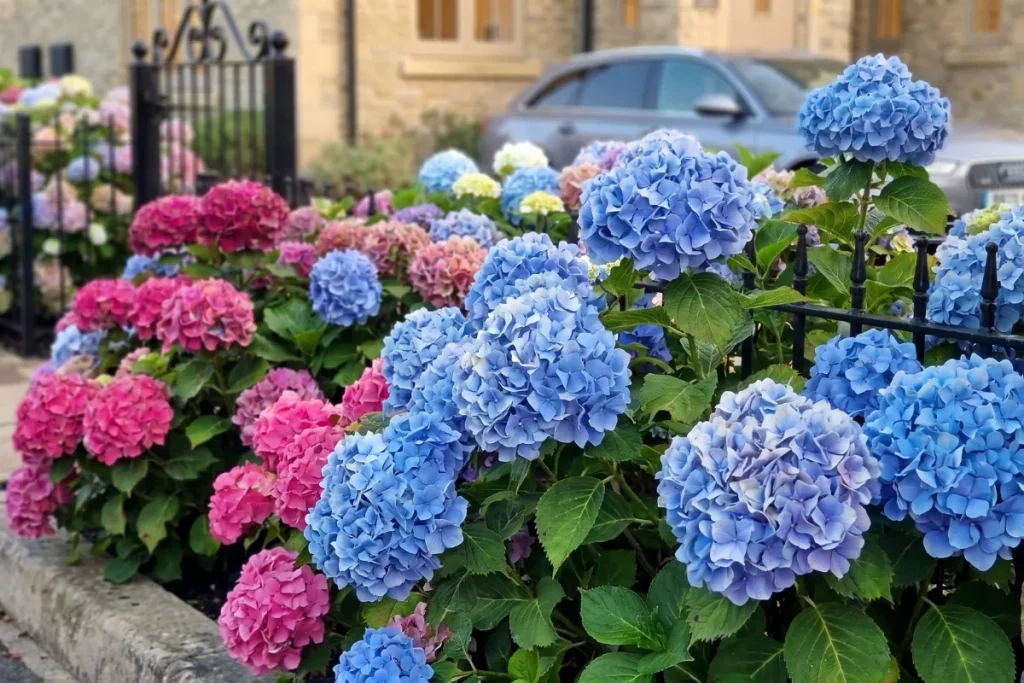
The wild mix of blue and hot pink along one single fence run is pure chemistry at work. It is not several mixed nursery varieties thrown together at random. Hydrangea macrophylla flowers react directly to free aluminum ions in the root bed.
Blue petals demand acidic ground. When soil pH drops below 5.5, aluminum moves freely into the sap stream, turning the bloom clusters vivid azure and deep cornflower. Move the pH needle up past 6.5, and that aluminum locks up hard in the clay. Without it, the plant produces pure pink and magenta heads.
Look at where the pink heads cluster. They sit tight along the house wall and the stone curb trench. Lime leaches out of fresh mortar joints and limestone sub-base aggregates over years of rain cycles. That steady lime wash raises the local pH around those specific roots. Meanwhile, shrubs set two paces farther away catch pure rainwater and decaying leaf litter, staying acidic enough to pump out rich blue heads. Gardeners who want that contrast leave the soil alone. If you want uniform blue, you fork in elemental sulfur and iron sulfate every spring. If you want pink, you dust agricultural limestone over the mulch and let the rain wash it down to the roots.
Discover more practical planting palettes, architectural details, and residential curb appeal guides on BySophieSweet.com. See how raised masonry elevates vibrant blooms in our guide to front garden retaining walls and stone bay curb appeal, or explore compact space solutions with our look at small front garden designs, hydrangeas, and structural planting.